Root Causes is a policy analysis series by the Natrona Collective Health Trust, grounded in rigorous, nonpartisan research. Each installment examines the systems, data, and decisions that shape the health and well-being of Natrona County residents by going beyond the headlines to understand why things are the way they are, and what it means for the people who live here. We believe an informed community is a healthier one. If you have a topic suggestion or question, reach out to Rachel Bouzis, Director of Policy & Learning.
The Deception
In the summer of 2022, gas topped $5 a gallon as the nation faced the worst inflationary crisis since the 1970s. Congress was debating the Inflation Reduction Act, which included a landmark provision: for the first time, the federal government would be authorized to negotiate what Medicare pays for certain prescription drugs. Into that anxious moment stepped a group called Seniors 4 Better Care, with ads warning that the legislation would “strip $300 billion dollars from Medicare, money older Americans rely on for their medicine, their treatments, their cures.” For someone on a fixed income watching prices climb on everything from groceries to utilities, the threat of losing access to insulin or blood thinners is more than enough to sway a vote; it’s life or death.
Seniors 4 Better Care sounds honorable, trustworthy, even a little folksy. This group would definitely be working in the best interests of a population managing multiple medications and likely different health conditions. Right? After a bit of digging into corporate registration filings, you would learn that behind Seniors 4 Better Care is the equally nebulously titled American Prosperity Alliance. Who is that? Well, if — several months after initially seeing the ad, thanks to lagging disclosure timelines — you were willing or able to dig through IRS tax filings, Senate lobbying disclosure records, and nonprofit financial databases, you might eventually find out that the group is run by former pharmaceutical lobbyists[1]. It would be difficult, but you might eventually be able to connect American Prosperity Alliance to the American Action Network, a nonprofit that receives funding from pharmaceutical companies like Eli Lilly and Johnson & Johnson — both of which stood to lose revenue under the negotiation program[2].
Through all of this follow-the-yarn detective work, it’s easy to lose sight of the original claim: that the IRA would strip $300 billion from Medicare. In reality, the Congressional Budget Office estimated that price negotiations would save the government nearly $300 billion — not by cutting benefits, but by reducing what Medicare pays for the same medications seniors are already receiving[3]. That’s the difference between a cut and a negotiation. When you know who is behind the ad, the blatant misrepresentation is obvious. But if you believe Seniors 4 Better Care is your ally, a group with your prescriptions and your health and your fixed income in mind, there’s no reason to question it. Of course, that’s the point.
Every bit of it — the misdirection, the conflicts of interest, the audacity — all perfectly legal.
In Wyoming, we’ve recently been through our own version of “abides by the letter of the law but fails the smell test,” albeit on a much smaller scale. The campaign checks Rebecca Bextel handed out on the Capitol floor in February amounted to just a few thousand dollars, but the implications felt priceless. Thanks in large part to exceptional Wyoming journalists, the public eventually learned just how extensive the scandal was, including the number of check recipients and Bextel’s personal stake in introduced legislation.
Every bit of it — the misdirection, the conflicts of interest, the audacity — all perfectly legal.
The Problem
Clearly, we’re not getting campaign spending right. In 2025, the Pew Research Center reported that 72% of Americans believe that “the role of money in politics” is a very big problem in our country today, coming in higher than any other issue including health care affordability and inflation[4]. An unrelated 2023 poll found that more than 87% of Wyoming residents consider the influence of money in politics a threat to democracy[5].
The Ruling
The villain is the Supreme Court’s 5-4 decision in Citizens United v. Federal Election Commission. The 2010 ruling held that the First Amendment bars Congress from limiting independent political spending by corporations, associations, or labor unions, so long as that money never flows directly to a candidate or campaign. The majority assumed this would not threaten election integrity, reasoning that such spending would be open to all candidates and parties, and that existing disclosure rules would ensure transparency[6]. In other words, the Court found that independent expenditures do not constitute corruption.
This case, along with the lesser-known 2010 ruling SpeechNow.org v. Federal Election Commission, paved the way for super PACs. The SpeechNow decision sanctioned unlimited advertising, so long as there was no coordination with campaigns. Obviously, the Court’s assumptions were incorrect:
The subject of Seniors 4 Better Care’s ads — whether seniors could afford the medications keeping them alive — could not have been more consequential. That entire operation, every ad, every false claim, every dollar spent deceiving seniors about their prescriptions, is a rounding error on what Elon Musk, the world’s richest man, spent on the 2024 election. For context, small-donor contributions to Donald Trump and Kamala Harris combined totaled $601 million[7]. Musk contributed more than $291 million by himself — and he wasn’t alone. Combined with just five other donors, that group contributed $989 million[8], 65% more than every small donor to both presidential campaigns combined. Contributions under $200 aren’t reported to the FEC, but if the average small donor gave $50, roughly 12 million people’s contributions were outweighed by six.
In 2024, roughly 300 billionaires and their immediate families contributed more than $3 billion to federal elections, accounting for 19% of all contributions — nearly a third of it from those 6 ultra-wealthy individuals[9].
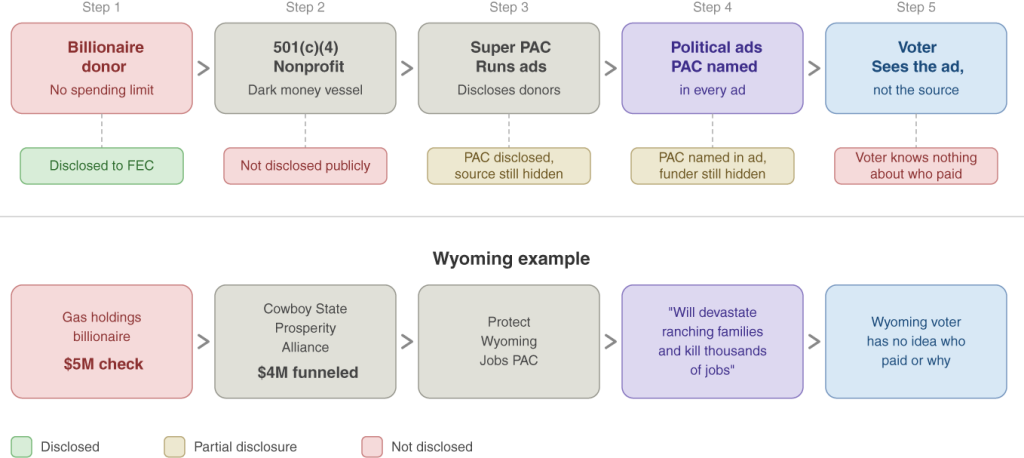
These amounts are spending floors — not ceilings. Thanks again to Citizens United and reporting rules, concealing super PAC funders makes filing your W-2 seem like corporate tax law. Though an ad must include who paid for it, and a super PAC must disclose its donors, that’s where the “transparency” ends. Many super PACs are funded by 501(c)(4)s, which don’t require any disclosure.
The Application
Say a Wyoming billionaire who owns vast natural gas holdings wants to block a state ballot initiative that would increase extraction taxes. He writes a $5 million check to a 501(c)(4) called Cowboy State Prosperity Alliance, which describes itself as a “grassroots organization dedicated to Wyoming’s economic future.” The (c)(4) funnels $4 million to a super PAC called Protect Wyoming Jobs, which runs a blitz of ads warning that the initiative will “devastate ranching families and kill thousands of jobs.” Nobody watching those ads has any way of knowing they were paid for by the man who stands to lose the most if the measure passes. This is dark money in its purest form.
The Proximity
If it seems far-fetched that Wyoming could be targeted, it’s not. According to FEC reports, Virginia-based Make Liberty Win raised nearly $9 million without a single donation from Wyoming. The group spent more than any other organization during the primaries[10], shelling out more than $370,000[11]. Perhaps they should have budgeted more for research, as their mailers included incorrect dates and even the wrong photo of a candidate they were endorsing[12]. Rather than Keith Kennedy from Cheyenne running for Wyoming Senate on their postcard, they used a photo of a Keith Kennedy from Virginia, presumably the first result when you’re Googling from a Virginia office.
Closer to home, 501(c)(3) Honor Wyoming spent between $106,500 and $168,203 on 1,241 Facebook and Instagram ads from Jan. 2023 to Dec. 2024, according to this Meta ad library search. Although (c)(3)s must disclose their donors to the IRS, that information isn’t available to the public. There is no way to know who is bankrolling Honor Wyoming or what they stand to gain.
In the same icky way that Seniors 4 Better Care gets to legally masquerade as an advocate for seniors and Rebecca Bextel gets to legally hand out checks on the Capitol floor, insurance companies get to legally decide what’s medically necessary for patients. These aren’t accidents or oversights; they’re features of a system designed by and for people with enough money to shape it. Wyoming communities deserve policies that prioritize their health, not the bottom lines of wealthy donors who will never have to live with the consequences.
The Antidote
Voting is a social determinant of health. The representatives we elect determine whether Medicaid gets funded, whether our air and water are protected, and whether behavioral health care remains accessible. Approach every political ad with scrutiny and skepticism. Better yet, talk to candidates and elected officials face-to-face — we have that opportunity here in Wyoming — and ask where they stand on campaign finance reform. Then vote like your health depends on it, because it does.
Sources
[1] The Rampant Reach of Pharma’s Hidden Hand
[2] Ibid
[3] No, the Senate-Passed Reconciliation Bill Won’t Strip $300 Billion From Medicare
[4] Americans Continue to View Several Economic Issues as Top National Problems
[5] Citizen Data 2023 Wyoming Poll
[6] Citizens United, Explained
[7] Small Donor Donations as a Percentage of Total Fundraising, Current Candidates Only
[8] Elon Musk tops list of 2024 political donors, but five others gave more than $100 million
[9] The Scale of Billionaires’ Campaign Donations is Overwhelming U.S. Politics
[10] Out-of-state money and a governor splashing cash – who spent big on Wyoming races
[11] As candidates spend big, one out-of-state group injects $370K into Wyoming’s primaries
[12] Virginia-based PAC spreads misinformation in Wyoming legislative races