What we're learning about health
in Natrona County
The cost of living is a health issue. So is housing, mental health access, and whether you have a job that pays enough. Over the past year, the Natrona Collective Health Trust listened to residents and dug into the data. This page shares what we found.
We were created to invest in this community's health.
In 2020, the sale of Wyoming Medical Center created the Trust, a private foundation with one purpose: improving health in Natrona County. We've been grantmaking since 2021, and demand has grown faster than our dollars can stretch. So while that work continued, we spent the past year asking a harder question: are we investing in the right things?
How the funding gap has grown →We listened before we planned.
Six methods over the past year. Before we decided anything about our next five years, we went out and asked.
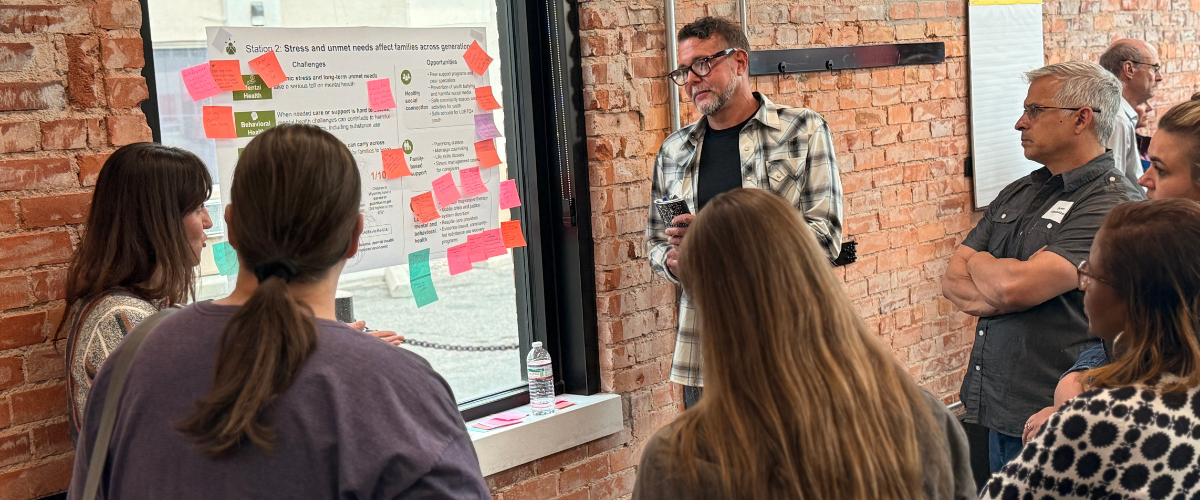
The same stories came up again and again.
Working hard and still falling behind
Families described earning too much to qualify for help but not enough to cover the basics, and choosing between health coverage and rent, groceries, or child care.
Help exists, but it's hard to reach
Resources felt scattered. Paperwork often meant taking time off work, online portals were hard to use, and there are too few Spanish-language navigators.
Care can mean leaving town
Parents described traveling out of state, at their own expense, for pediatric mental and behavioral health care they couldn't find locally.
Paraphrased themes from community focus groups and interviews, spring 2026. Not direct quotes from any one person.
Health is shaped by more than healthcare.
Researchers draw a distinction between health factors and health outcomes. Outcomes are the results: how long people live, whether they get sick. Factors are the conditions that produce those results. Stable housing. A job that pays enough. Mental health support when someone needs it. A safe community to come home to.
Change the factors, and the outcomes change with them. That is the whole logic behind community investment in health, and why a health foundation cares about the cost of living and housing access, not just what happens at a doctor's office.
Read more: What we mean when we say health →The research points to three connected problems.
Each one builds on the last. Each opens in a new tab.

When crisis starts young
What early adversity looks like in Natrona County: parents in jail, violence at home, gaps in prenatal care, rising mental distress, and kids feeling it earlier.

Who carries the most weight
Which Natrona County residents face the most barriers day to day: single mothers, older adults still working to make ends meet, and residents navigating systems that weren't built with them in mind.

A safety net with too many gaps
The structural reasons families aren't getting help, and why the systems meant to catch them aren't keeping up. Wyoming statewide data.
Closing these gaps is fiscally sound, not just compassionate.
Treating problems upstream costs less than responding to them in crisis. Here are the numbers.
Median return for every $1 invested in public health, across 52 studies
Masters et al., Journal of Epidemiology and Community Health, 2017Up to $17 a day for sober living, compared with $147 a day in the Natrona County jail
NCSJ Rocket Docket program data, 2025A primary care visit in Casper, compared with $1,029 to $2,450 for a Level 4 ER visit for the same condition
Banner Health price transparency file, 2026Sharing what we learned.
This page and the three data stories above.
New strategic direction announced.
We'll share where the Trust is headed at our annual Give Thanks event on Nov. 19, and publicly the same week.
Five-year implementation begins.
Our next chapter of grantmaking, programs, and partnerships, shaped by everything we've learned this year.
The weight falls hardest on those with the least margin.
Let's work together to fix this.
Follow along with the work being done in our community to solve these issues and more, and get updates about our new strategic direction.