Show Your Work is a 7-part series from the Health Trust on how we operate, how we make decisions, and why we think the community deserves more than our word for it.
When people ask why we fund a boxing club, a reentry program, or a music therapy nonprofit, they are really asking one bigger question: What does any of this have to do with health?
The answer starts with a distinction researchers make between two things: health factors and health outcomes.
Health outcomes are the results. How long people live. Whether they get sick. Health factors are the conditions that produce those results. Whether someone has stable housing, a good school, a job that pays enough, a safe place to spend an afternoon. Change the factors, and the outcomes change with them. That is the whole logic behind community investment.
What the data actually shows
Every year, the County Health Rankings & Roadmaps program, a partnership between the University of Wisconsin Population Health Institute and the Robert Wood Johnson Foundation, maps this out for every county in the country, including all 23 in Wyoming.
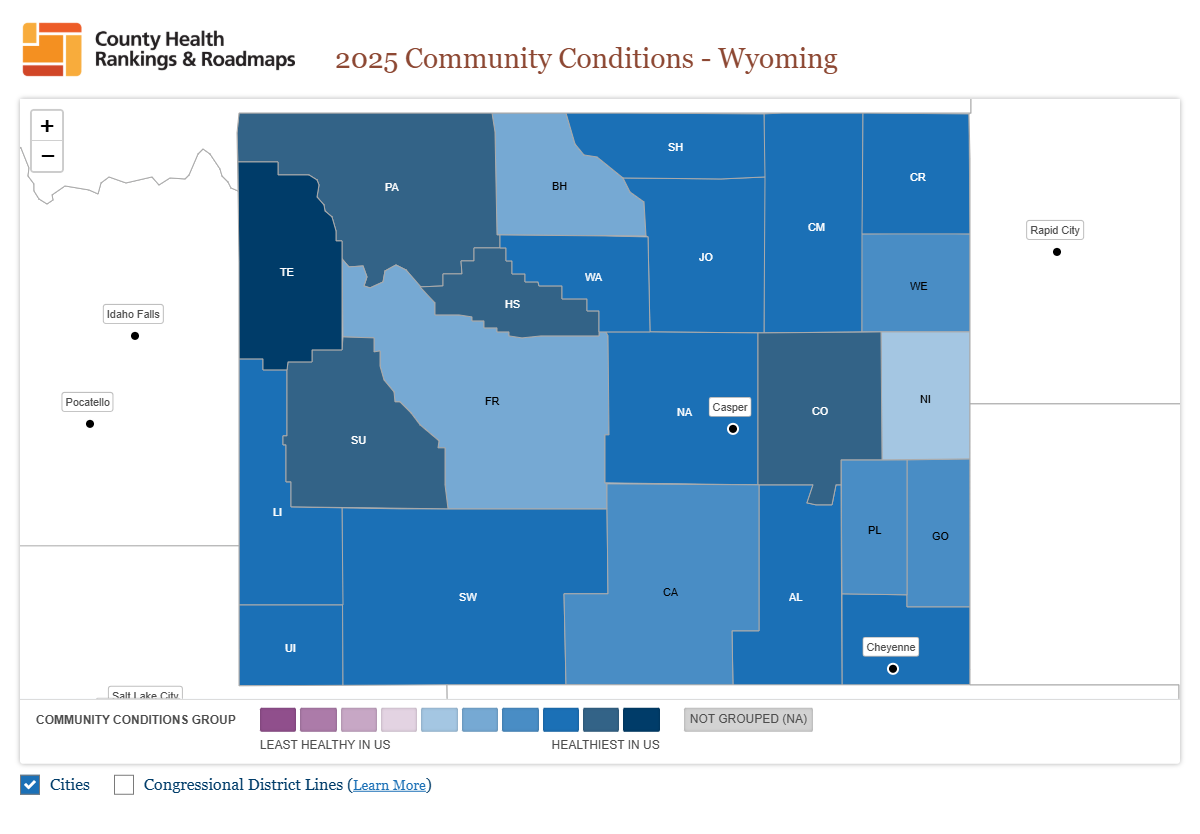
This map shows health factors: education, jobs, clinical care access, housing, the physical environment. The conditions.
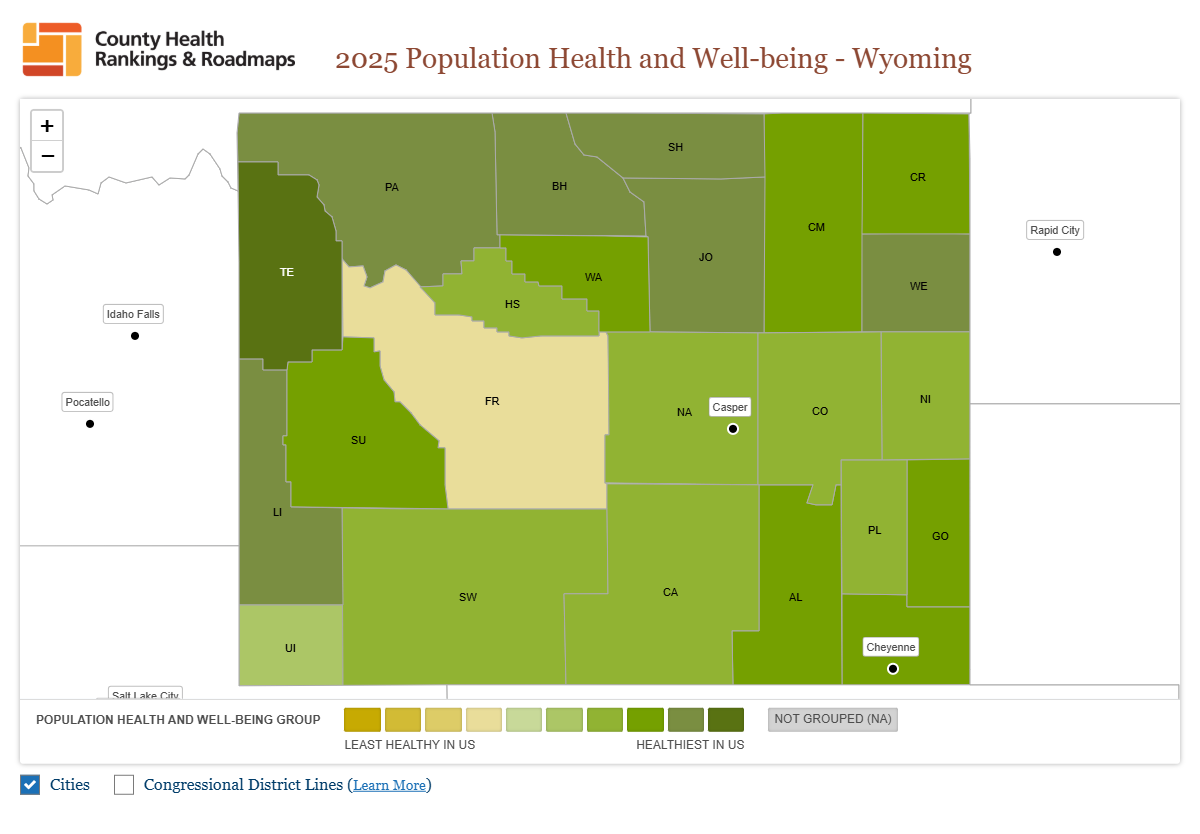
This map shows health outcomes: how long people live and how healthy they are while they’re living. The results.
Source: County Health Rankings & Roadmaps, a program of the University of Wisconsin Population Health Institute with support from the Robert Wood Johnson Foundation, 2025 data.
Line the two maps up and a pattern holds across the state. Counties with stronger factors tend to land in the healthier bands on the outcomes map too. That is not a coincidence. It is the reason a health foundation spends money on a boxing gym, a reentry program, and a home-visiting service instead of only writing checks to clinics.
Why childhood is where this compounds
Some of the clearest evidence on health factors and outcomes comes from research on what happens to kids before they turn 18.
The CDC has spent years tracking difficult experiences in childhood: things like violence in the home, a parent’s substance use, a period of real instability. Their data shows these experiences are common. Most high school students report at least one. And the more a child experiences, the more likely they are to face specific health problems later: heart disease, depression, suicide risk, smoking, risky sexual behavior among them. This is not a moral failing on the part of the kid or the family. It is what sustained stress does to a developing brain and body.
That is exactly why our partners’ work matters so much for kids specifically. A gym, a mentor, a case manager, a home visitor, all of it exists to interrupt that pattern before it sets.
What actually interrupts it
Researchers call the things that lower a child’s risk protective factors, and they are specific and well documented. The CDC’s own research points to a short list: a caring adult outside the family who acts as a mentor. A safe, stable home. Positive friendships. A community with after-school programs and activities kids can actually get to.
Read that list again and it is describing our grant partners by name. Here are a few examples.
The Casper Boxing Club gets Trust funding because it keeps at-risk youth physically active and connected to a structured, caring environment outside of school. It is an alternative to the justice system for kids who need one. The outcome is not a punching technique. The outcome is a teenager who stays in school, stays out of the emergency room, and has a consistent adult in their corner. That is a protective factor, funded.
Mercer Family Resource Center gets Trust funding for a different piece of the same picture. Its parenting classes, substance use and mental health early intervention, and mentoring and life-skills workshops work with the whole family, not just the child, and it runs the Youth Empowerment Council, a substance-free, youth-led group for grades 6 through 12 where teens organize community service projects and train their own peers on suicide prevention. Where the boxing club builds resilience in a kid directly, Mercer works further upstream, strengthening the household around that kid before a crisis has a chance to take hold.
Hope House gets Trust funding because it provides recovery and reentry support for men leaving incarceration. People leaving incarceration without housing, employment, or a support system have high rates of emergency room use, re-incarceration, and preventable death. When Hope House works, it keeps people housed and in recovery. Fewer emergency room visits. Less pressure on the justice system. More people connected to the workforce.
Parents as Teachers gets Trust funding because the first five years of a child’s life are the most critical window for brain development. What happens in that window shapes educational outcomes, behavioral health outcomes, and economic outcomes for the rest of a person’s life. Investing in families during those years is one of the highest-return community investments that exists.
The environment around the family matters too
Health factors are not only about individual families. They are about the place a family lives in.
A good public school system produces better health outcomes down the line, not just better test scores. A local economy with steady jobs means fewer families under the kind of financial strain that erodes health. A downtown where people want to spend time and where there is somewhere to go is itself a health factor. A community where people can live, work, play, and find connection is not just convenient. It reduces the isolation and chronic stress that erode health over time. Keeping people rooted in one place is protective for the same reasons a mentor or a stable home is.
This is also where arts and culture fit in, and where foundations occupy a role that government usually can’t. Cities and counties fund roads, schools, and clinics. They rarely fund a theater, a mural, a music program, or a cultural festival, and they are not built to. Foundations are. Research demonstrates what community members have long said directly. A 2017 University of Pennsylvania study of New York City neighborhoods found that areas with more cultural resources, arts nonprofits, working artists, cultural participants, showed measurably better health outcomes than similar neighborhoods with fewer creative resources, even after accounting for income, race, and ethnicity. The researchers were careful to note this shows correlation, not proof that arts access alone causes better health. But the pattern held across the city.
Locally, that intersection is not theoretical. VIBES Fine & Performing Arts runs a clinical, evidence-based music therapy program in Casper, partnering with the Olivia Caldwell Foundation, Banner Health, and the Wyoming Behavioral Institute to reach people with developmental, emotional, and sensory needs. That is arts and clinical health care meeting in the same room. The arts are not decoration on top of a healthy community. They are part of what makes a community healthy.
Every organization the Trust funds connects to health in some form. If it does not, we do not fund it. The definition of health we work from is not the one on a hospital intake form. It is the one that explains why communities with strong social infrastructure have longer life expectancy, lower rates of chronic disease, fewer emergency room visits, and more stable families than communities that don’t.
That broader definition is not a philosophical position. It is what the evidence supports. And it is what guides every dollar the Trust puts into the community.
Want to see how the data breaks down for Natrona County specifically? Check out our Grantmaking page for the full rubric and focus areas behind these decisions.
Recent Posts
-
 New research finds health challenges facing Natrona County run deeper than the clinic
 -
You’ve probably benefited from this, even if you don’t know it.
-
When government funding disappeared, 64 Natrona County families kept their heat
-
The Civics Prescription: How Voting Shapes Your Health
-
Primary Concerns: Cost, Care, and the Choices Ahead